
Can I use brake fluid for my hydraulic system? Is brake fluid an easy option?
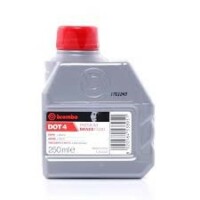
Brake fluid may be carefully formulated for automotive braking, but how good is it elsewhere in a hydraulic system?
The answer is yes, to a point. However, you must be very careful. It is specialist and certainly isn’t suitable as a substitute for all applications. Where safety is critical, we would never change away from the design-specified fluid anyway. Let’s remember there is a difference between a substitute fluid in the direst emergency and simply swapping fluids because it is easy.
The advantages of brake fluid are convenience: you can buy it at any auto store and don’t have to buy 20 litres. Those might well be big pluses, but the engineering is everything. Is it the right fluid? Once you dig into all the issues around this fluid, you might have second thoughts and operate on conventional mineral oil. But some other specialist hydraulics do make it work with massive success. There are lots of formulations of hydraulic fluids for particular applications that aren’t that far away from glycol brake fluids in composition, so this isn’t a bad question to ask. The key words are “specialist” and “formulations.” Select your fluid carefully. Most important, find out what it is in more general terms.
Brake fluid is probably the most commonly used hydraulic fluid if you look at all the automotive brake and clutch hydraulics in use in the world. Hedges & Company on the web tells us there are 1.4 billion cars in the world. Add in commercials plus motorcycles and you have a massive user base. Keep in mind that Shimano brakes on bicycles use mineral oil. That’s interesting. We have looked previously at what a massive success these miniature hydraulic systems are. If brakes and clutches are a very specialist application of miniature hydraulics for the precise requirement, we think the development of hydraulic fluids for them has ended up quite niche. Brake fluid is generally a specialist hydraulic fluid tailored for this exact use. We wouldn’t use it just because small bottles are available at every auto store. The application and fluid properties are quite precise. Then add in the specific recommendations for looking after your glycol-based brake fluids and that tells us to think carefully before using it in place of mineral oil. We’ll briefly talk about looking after brake fluid as a hydraulic fluid as a heading later.
Who invented brake fluid?
Hydraulic brakes go right back to pioneering systems by Duesenberg in the USA in 1914 and inventions by Malcolm Loughead, the founder of Lockheed. Hydraulic braking must have been quite slow to be universally implemented, as VW were still using cable brakes on the Beetle up to around 1960. There is plenty of background on the web.
Why isn’t mineral oil used in automotive braking systems?
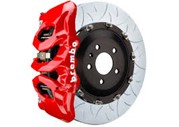
There are some very precise and unique requirements for the hydraulic fluid in an automotive braking system. Image courtesy Brembo
The web tells us that quite early on it became apparent that mineral oil didn’t absorb water. Why does this matter? There was a specific issue with braking systems where under very heavy and hot braking, the water could boil and make the system inoperable.
What brake fluids are used today?
There are plenty of web resources on the various DOT designations for brake fluid. (DOT stands for the US Department of Transport.) We have discussed briefly water glycol fluids, mineral oil-based fluids and we will later mention silicone oil-based fluids. This US guide is comprehensive and explains all.
What does my auto shop do when it “tests” my brake fluid?
Hydraulics people tend to see mineral oil as quite a forgiving fluid for long term use. Yes, cleanliness is everything, but that is true of any hydraulic fluid.
Why is silicone brake fluid used?
Silicone brake fluid is a specialist “DOT 5” fluid used on military vehicle, classic or show cars and niche applications, so we are told. Note that silicone oil used as a brake fluid does not absorb water unlike glycol-based fluids. It also has a high boiling point. There must still be the issue of water droplets turning to gas at high temperatures, but maybe this is a low risk nowadays. Tell us the answer! In our hydraulics world, silicone oil is used in specialist hydraulic applications like calibration and damping.
Would I use glycol brake fluid on a hydraulic system with a motor driven pump?
We would say no. Mineral oil is a very good lubricant for elastomeric seals. Clearly, an automotive braking system uses rubber seals, but they will be assembled with grease and relatively speaking, the number of cycles isn’t massive compared with a powered system. Again, the relatively slow speeds of operation of the brake system seals and the limited number of cycles over a lifetime are one factor in allowing the use of water glycols. Move to lots of cycles at higher speed and you either change to mineral oil or a glycol-based fluid with “slippery” additives in it or go the route water hydraulics people like us go and use capped seals in materials like filled PTFE or UHMWP. Using elastomeric seals on a hydraulic fluid with poor “lubricity” can be very problematic. Beware.
What about other water glycol-based fluids for hydraulics?
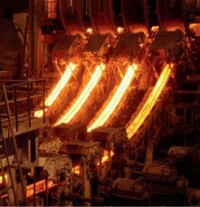
A steel mill can’t risk inflammable hydraulic fluid and would use Houghtosafe 620 or similar in place of mineral oil
If you look slightly away from glycol-based brake fluids for your hydraulics, you are into quite a big sector of the hydraulic fluids market. We have previously asked the question “can I use tap water for my hydraulics?” It is a great white paper well worth a read. Once again, you are picking the properties that you need in a hydraulic fluid and formulating a recipe to meet that requirement. Maybe one “simple” application is the offshore control fluid mentioned previously.
Is a water glycol brake fluid better for the environment than mineral oil?

Oil spills and the contamination of any water is an environmental disaster.
Our original customer in 1982 was a firm who wanted to use water for a trench shoring system. As we have noted, that is a fine idea except that water invariably needs a biocide for extended use and immediately you are moving towards a formulation or cocktail to provide your fluid. Weaning the world off mineral oil is most definitely the future. Just be aware that although water-based fluids like water glycols offer a solution, use and disposal of them isn’t without issues. Water Glycol “Antifreeze” is quite toxic, so care needs to be taken. There is an issue here with diethylene glycol, as outlined on the web. Beware.
Which hand pumps will work on brake fluid? What is special about a Micropac pump?
There are a few issues here that our Micropac pumps address. The starting point is that you need the right SEALS. Our kit has always been designed to allow us to offer different grades of elastomer easily and cheaply. If the brake fluid is low viscosity, you would be wise to use a pump like our MW with a poppet outlet non return valve and a soft seat release valve. Designs that use a ball peened into a metal seat aren’t our choice for low viscosity fluids. Low corrosion materials like stainless steel 316 would be our first choice. Use anodised alloy if you are careful with the state of the fluid. Finally, if you ask for the pump to be tested on brake fluid, that’s what we will do. The big manufacturers are unlikely to offer that service. Look at our MW series, MP carry arounds, the MB low pressure high-capacity units or the MT-6 cartridge pump for low viscosities. Talk to us about your application.
We are the Multifluid pump specialists.
Our pumps were designed over 40 years ago to allow you to use the correct materials and seal compounds for your fluid. You configure precisely what you need. After all these decades, we are the experts. Contact us.
We hope you found this paper useful. We are not chemists or physicists, so feel free to comment and help us understand better.

Was happy to find this article. I recently poured DOT4 brake fluid into the power steering reservoir on my 2001 Astro. The reservoir was unlabeled and it was connected to the master cylinder. So I made a mistake. I didn’t think it would hurt anything but I wanted to flush it out anyway and put the ATF in it. All the mechanics I talked to made prophecies of doom. One even said I should flush the brake system…which is not even connected to the power brake system except mechanically. Its been a week so far and I haven’t gotten around to the flush yet, but its good to know I didn’t hurt anything in the near term.
Jim, Thanks for reaching out. In dire emergency where you a facing disaster and nothing else is available, the brake fluid might be a stop gap to the next garage. We were thinking danger to life and that sort of emergency. Stuck in the middle of nowhere and so on. Remember your seal compound is different for ATF, so that will need addressing. We would worry about using brake fluid in the pump on the power steering. A gear pump won’t like it. You certainly don’t want it failing in service. It sounds like quite a tiresome mistake. Quite a big service job we think.