How do I pressure test my composite overwrapped pressure vessels or COPV? Can a Micropac® PTR-A programmable hydrostatic pressure cycle tester provide effective testing at low cost?
Composites have been a massive growth area in the last few decades. Some applications are designing and manufacturing massively strong structures at a low mass that was previously unthinkable. Engineers are always excited about designing the impossible. Think a McLaren sports car or Boeing Dreamliner. Pressure vessels might well be the perfect application for composites in some applications.
In our basic white paper “Why are composites the future for so many pressure vessels?”, we have discussed the basics of composite overwrapped pressure vessels (COPV’s), We talked about why this technology is so strong, the types of COPV and some basics on why one would fail. Let’s have a very minimal recap on the basics just to explain the move from metallic pressure vessels to composite. We will then dig into specialist testing at different stages in the manufacturing process together with some of the specific requirements and why.
If you have already read our white paper, “Why are composites the future for so many pressure vessels?” then move quickly through the recap headings and don’t read more.
Why would you use a composite overwrapped pressure vessel or COPV?
Let’s start with the accepted generic name. These are Composite Overwrapped Pressure Vessels or COPV’s.
You would be chasing the benefits of reduced mass over metallic components and maybe low corrosion with the right variant of composite vessel. For example, the cost saving in transporting truckloads of lower mass composite gas bottles compared with metallic bottles over the same period might be dramatic, the composite pressure vessel might even make your product viable and push a technology beyond what was previously possible. An ultra high pressure hydrogen reservoir for the boot of a car would undoubtedly be ridiculously heavy in metal.
Luxfer type 4 composite gas bottle widely used now. Copyright Luxfer
When wouldn’t you use a composite pressure vessel?
If you are chasing low cost, then you wouldn’t be specifying a composite overwrapped pressure vessel.
The mainstream manufacturing process of winding is too laborious. We are happy to be corrected and told about an application of manufacturing process that makes composite competitive with metallic.
What is a composite?
Just to clarify this very basic question. The broad definition would be a structure made up from two or more different materials forming one assembly with properties superior to the constituents.
We are interested in fibre composites. A composite is fibres of one material in a matrix of another material. Medieval builders might have used horsehair in render to enhance properties. Today look at glass or carbon fibres in an epoxy or polyester matrix. The web is very good with resources. Composites are massively important is so many areas. Low mass and high strength are big drivers. Low mass saves energy in moving things around. Add in low radar signature stealth technology for military applications. Then you have the possibility of manufacturing something that simply cannot be achieved using conventional technologies or making it considerably lighter. Composites are already massive and will continue to boom.
What is a pressure vessel?
A container for pressurised fluid.
Sometimes one homogenous material that forms a leak tight receptacle although you might achieve the same result with a flexible bag within rigid walls. The web is good on varieties of vessel. Let’s move on to TYPES of pressure vessel, as this is our starting point.
A composite motorsport accumulator Copyright EHFCV
What types of composite pressure vessel are used?
We have explained these already in our general composite overwrapped pressure vessel paper. This is our second white paper that digs into the testing of composite pressure vessels and what kit we supply to manufacturers.
One point that is worth making from an engineering standpoint is that whatever type of COPV we are talking about, testing methodology is the same and looks at the test results. It will be the test parameters that may vary depending upon the designed duty of the unit or Engineering Standard that it is designed to.
If you need a recap on types of vessels;
Vessels are classified as different types according to the method of construction.
This is a key question and comes down to materials and the way it is made. The end result of a vessel that safely contains pressurised media is the same, however it is made. You could be talking a traditional METALLIC pressure vessel from sheet metal, machined from solid or tubular with solid ends. Different industries probably have other basic ways of achieving a metallic pressure vessel. Metallic pressure vessels are a well-understood legacy product that has been around since the Industrial Revolution. For example, we bought in an aluminium, high pressure gas bottle from Luxfer. A great product where innovative manufacturing has been used to achieve what is required. This uses a cold impact extrusion process. Very impressive really. A metallic pressure vessel would be classified as “Type 1.” Luxfer actually manufacture all the different types of vessels discussed here, so their web site is very useful.
Let’s move to COMPOSITE pressure vessels and these are categorised types 2 and 3 metallic liner over-wound with composite, type 4 non-metallic liner over-wound with composite and finally type 5 which is all composite. Type 2 and 3 differ slightly. Type 2 reinforces the metallic former on the diameter and type 3 over its whole area for greater strength. We are not composite people, but keep in mind that a liner might be used to provide an “easy” former upon which to wind your composite to provide a high integrity vessel or you may need a liner for gas duty where molecules can diffuse through your composite matrix. In the limit, high pressure hydrogen storage composite vessels can be incredibly demanding on system integrity due to the very small molecules. That readily diffuse into other materials. So, there can be another aspect to liners.
Once you have made your composite vessel by whatever means, we understand that the testing is the same, as it is the result that matters. As we will discuss later, the failure of a composite structure can be very complicated.
In our basics paper we sing the praises of a guide on Composite Overwrapped Pressure Vessels or COPV’s by Advanced Structural Technologies. There is an excellent explanation of these types and a tabular presentation on features and benefits.
Why take pressure vessels very seriously?
The simple answer is danger to life.
You are storing energy. In some systems, the issue of the implications of catastrophic failure arises if the energy stored is lost. If a pressure vessel leaks or bursts the results can range between annoying and inconvenient through to a massive danger to life. Add in heat, pressure and large volumes such as steam boilers and failure is very high risk. Or massive numbers of one design that has high inherent risk. Think vehicle fuel tanks working on very low pressures but with lots of pressure cycles and highly inflammable vapour. If there is a single point of failure and high risk to life, that is a significant risk that should be tested. Think of the oxygen pressure vessel bursting on Apollo 13, although we are told that was an explosion in the reservoir. New technology or a new application for materials such as composites brings new risks to be assessed. There are always uncertainties in new designs and materials. In our more detailed testing paper, we do consider the various manufacturing and testing standards for composite vessels.
Why is hydrostatic pressure testing of a composite pressure vessel (COPV) a whole lot more demanding than testing a metallic pressure vessel? Will our catalogue PTR-A do your composite testing job instead of a mega expensive rig or using a test house?
Testing a metallic pressure vessel using a hydrostatic pressure test rig is fairly easy. In the simplest case, connect up a Micropac test pump and carry out your procedure. You will have risk assessed the job, know what the procedure is and are able to record your results. Our web resource sets all this out. If you need to fatigue test using a large number of cycles repeated, our PTR-A catalogue programmable test unit provides a very cost effective solution for components such as sheet metal or moulded plastic automotive fuel tanks. Customers even use the PTR-A to cycle test or MW pump to proof pressure test smaller moulded vessels right down to carbonated drinks bottles.
Move on to composite overwrapped pressure vessels a lot more parameters come into testing. We will discuss these further.
What are statutory standards for metallic and composite pressure vessels?
The common pressure vessel standards are EN 13445 (EU) and PD5500 (UK). But there are many more relating to special applications. We discuss some of these below.
You may be performing basic testing on the working pressure of whatever you are testing plus a safety factor. You are testing to check for leakage or permanent deformation. The EU PED (Pressure Equipment Directive)2014/68/EU is always a good start whatever you are testing, whether it is components, systems and metallic vessels. It is looking at the medium, system volume and pressure as basic parameters. That is very sensible. High pressure 700 bar but a very small volume on water? That is manageable. 500 litres on high pressure gas? That’s terribly high risk for all involved. The graph in the standard is thoughtful, whatever you are doing.
Dial up requirements to more specific components with special needs and you are looking at statutory regulations. Are you testing fire extinguishers? Look at BS/EN 3. There is a burst test requirement here typically using a Micropac test pump, but composite fire extinguishers need to be cycle tested 12,000 times to 25 bar. Are you testing metallic Pressure Vessels? Look at BS/EN 13445 or the US ASME Boiler Standard. Again, Micropac pumps are used worldwide for this application. Some pressure vessels are specialist. An automotive or marine fuel tank is a pressure vessel, albeit at very low pressure. Look at standard UNEC Regulation 34 and it is soon clear that you need to cyclically pressure test the unit to simulate extended use. People might use our catalogue PTR-A programmable pressure tester for exactly this application. A test might be 10,000 cycles at 2psi/0.138 barg. Fuel tank testing is a deep subject, so take advice. The PTR-A is an easy and cost effective solution. Fuel tanks were our first application for our PTR-A programmable pressure cycle tester years ago.
Consider testing composite pressure vessels and you find that requirements are much more comprehensive. A simple explanation is probably that failure of a composite vessel is much more spectacular and absolute plus the mode of failure isn’t the same as metal. In a metal part, it is elastic up to a point. This means that it springs back to where it was at zero pressure with no load. At some loading, the metal starts to yield and take a permanent set when the loading (in our case the pressure) is removed. Ultimately, the material will fail. Testing will need to address yielding as well as total failure. For example, metallic gas bottles are tested in a water jacket that shows very clearly whether the bottle has “grown” due to yielding of the material.
What is different in the testing of composites? The way that composites work and provide strength directs you down a very different testing path. You are considering the need to still proof test to a maximum pressure plus a margin. Then test over a number of cycles but add in the need to test at high and low temperatures plus have control over the rate of increase in test pressure. The reason why we are introducing these additional constraints comes back to the inherent properties and failure modes of composite materials. For example, testing of the composite versions of gas bottles will be considerably extended and include high cycle pressure testing. Consult standard ISO11623:2015. Composite reverse osmosis vessels might include a basic hydrostatic test of 1.5 times the working pressure, a burst test of four to six times working pressure without catastrophic failure but then bolt on an extended pressure cycling test of up to 250K cycles in response to the use of composites. Another even more demanding application is Compressed Natural Gas (CNG) storage using composite pressure vessels for vehicles. Standard EN 15935:2021 discusses test requirements which include up to 45K cycles at pressures. A range of different tests is described for different failure modes. A closely linked application is hydrogen pressure vessels for vehicles. As these are running at 350 or 700 bar, the pressure is relatively high. Note that hydrogen is commonly stored in a bag which in turn loads up the composite vessel that retains it. That won’t change the basic strength requirements. The bag is simply offering an impervious barrier.
Pressure testing of composite pressure vessels now used in so many areas is part of certification on these products. It is probably worth observing that we are all benefitting in some way from these highly innovative products but because there are these inherent complications in manufacturing and failure modes, the additional testing is mandatory. If there is risk to life, you can’t cope with this type of uncertainty.
We have talked about more general testing, but it is essential to place testing within your business activity, It may be design and development culminating in an approval to a standard, 100% testing during the manufacturing process or taking a sample of production and cycle or burst testing. Let’s consider these.
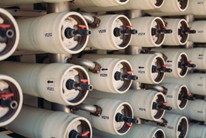
Ganged RO composite membrane vessels form very large desalination plants Copyright Veolia Water Tech.
What test procedure should I be using for my composite pressure vessel?
Let’s talk about the different rationale for testing at different stages in a manufacturing process.
Focus first on prototype design qualification pressure testing. Just to clarify that “prototype design qualification pressure testing” is the physical testing that is always carried out to check that your theoretical calculations in producing your design to work safely in use. It is just a step in the process. There could conceivably be a mistake in the design, something wrong in calculations or indeed a mode of failure brought about by particular service conditions that has been overlooked.
What are the essential three pressure testing requirements relating to composite pressure vessels?
If you are taking a composite overwrapped pressure vessel through from design to production, let’s make sure we are very clear on where hydrostatic pressure testing of your vessel fits in for composite pressure vessel manufacturers.
Firstly, those relating to design qualification testing for your composite pressure vessel product. The difference between an all-metal pressure vessel and anything involving composites is that with an all-metal design, you can use calculations to demonstrate design integrity and put in temperature and corrosion factors, so you don’t have to cycle pressure test at temperature extremes. A composite vessel test involves hydrostatic ambient and extreme temperature cycle testing (in ISO 19881 it is up to 30,000+ cycles) at defined pressurisation ramp-up rates. Look at the specific requirements of the applicable standard but expect to see both high and low temperatures. One of our customers was in discussion on requirements for qualification testing of Compressed Natural Gas (CNG) vessels for automotive applications. That required sophisticated testing with temperature and ramp up/ramp down parameters closely controlled. Our Technical Director is invariably of the view that the normal route for pressure test cycling in this instance would be through a third-party test house, owing to the sophistication of the test programmes. That is the testing to qualify the product for sale. Nevertheless, composite vessel manufacturers do buy our PTR-A pressure cycling rig for early stage testing of new designs up to high cycles before a products undergoes final testing. Development is always a tortuous process.
Secondly, once you are in production, there is hydrostatic testing of every cylinder which may typically be 150% nominal working pressure held for 30 seconds, no rate of pressurisation defined. That’s just our suggestion. In ISO 19881 it isn’t as simple as saying ‘yes it’s OK, no leak’; expansion has to be measured and there will be acceptance criteria defined by the manufacturer. Expansion would usually be recorded using the water jacket test i.e. immerse cylinder in water jacket, pressurise and record volume of displaced water from jacket. These water jacket tests have been applicable for decades for testing gas bottles. Clearly you can see the elastic deformation giving rise to expansion of the bottle. You might in the simplest case indicate this displaced water using the water level on a sight gauge. That is a very old means of testing, but quite foolproof. Release the pressure and the level will return to zero. Your criterion is “level returned to zero”, which is easier than measuring something. If the two levels differ, then you have plastic deformation of the test piece which isn’t acceptable in a pressure vessel of this type. The vessel would be rejected. The Micropac® PTR-A could surely be very useful here and needle valves would help control rates of pressurisation and reduction in pressure, dependant on maximum pressure capability. Over the decades, Micropac® hydrostatic pressure test pumps like our MW or PSP series pumps have been used for precisely this application on metallic vessels. If you need a rapid prefill or deskilled process, people might move to a DUO pump with air driven and manual pumps integrated into a neat cart unit. Our PTR-A programmable pressure test pump could deskill this production process. There is no specific requirement to offer a controlled ramp-up or ramp-down on the test pressure. Much will depend upon the volume of the composite pressure vessel and hose. There is an inbuilt needle valve to slow the pump flow and a hydraulic needle valve could be fitted in the flow line if some dampening of the rate of change of pressure is required, but this will not offer the control of a very expensive rig.
Thirdly, also as part of the production test, there is batch testing where one sample from a representative batch in manufacture is taken and burst tested. Here the rate of pressurisation is defined. For a known vessel volume plus its connection hose, the rate of increase in pressure and the reduction in pressure upon release can be measured. These may fall within your limits anyway. If you need more control and some dampening, the PTR-A can be used here provided needle valves could be used effectively to control pressurisation rate adequately and again dependant on maximum pressure capability. Customers use the PTR-A every day in production environments. They are a cost effective tool.
How does a composite pressure vessel burst in general terms?

A burst COPV. Why did it fail? Copyright Ability Composites.
The answer to this is much more complicated than a “simple” metallic pressure vessel.
“Excessive internal pressure” is a little more nuanced than simply pumping the pressure up to a figure, the metal yields and the part bursts. On a composite vessel, it could just be excessive pressure. Or pressure and heat combined. Or even raising the pressure at too high a rate. Bring in failure at a number of cycles or fatigue and temperature plus the rate of increase in pressure are key. Plus, the frequency on cycles. Needless to say, if you suffer a failure, not knowing this key information will make diagnosis and replicating the failure very long-winded. Does measurement of parameters and data logging become an important part of using composite pressure vessels? Certainly, you aren’t in a good place knowing nothing about the circumstances in which a high risk part failed catastrophically.
In talking about the failure of composite or any vessel, do factor in excessive heat or cold, some previous mechanical damage that might or might not have been repaired and finally simple manufacturing process failure. Any of those could cause a burst in unexpected circumstances.
What actually happens on a micro level when a composite vessel fails?
In a word, you might well see something sudden and spectacular, as the yielding of metal isn’t present to provide some sort of time delay. This failure of a composite structure is considerably more complicated than describing what happens when a metallic vessel fails. The complication corresponds to the additional parameters built into testing to a particular standard.
Individual fibres of the reinforcement material can fail, effectively by breaking. Another mode of failure at this micro level is fibres breaking their bond with the matrix that they are supported in. At a larger level, the matrix itself can crack due to stress and start a failure event. Finally, another failure mode is delamination where a small area of cracking between one layer of fibres and another can lead to whole layers of fibre lamination cracks relative to the next layer and a peeling effect. There are good web resources looking at modes of failure for composites.
In looking at a failure, one area of interest is layers of fibres laid up as a cylinder. Here hoop stress acting on the structure might suggest why it has failed. Move to features such as domed ends, bosses moulded in for fluid connection or mounting brackets or features and you introduce inconsistencies because you are not simply winding of layers of laminate. These complicated features might be the cause of a failure and very difficult to analyse with a view to addressing the issue.
Can I use my low cost catalogue Micropac® PTR-A for composite pressure vessel testing?
Most certainly yes, but specific test requirements may mean you need to make other plans at higher cost.
Our Micropac® PTR-A will be very effective in carrying out testing of a composite pressure vessel up to a point. Our unit is very inexpensive compared to sophisticated test rigs. Maybe a starting point is to look at your requirements and decide what the capabilities are for our unit. The previous section “What test procedure should I be using for my composite pressure vessel?” discusses where in the overall manufacturing process various different tests sit. As noted, composite pressure vessel manufacturers do recognise that a programmable pressure cycling rig at a reasonable price is a useful tool to have on site. That offers a different capability to our very widely used hydrostatic pressure test pumps like the Micropac® MW, MP, MD and DUO.
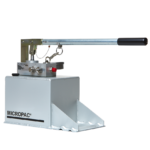
Aluminium alloy, double acting operation to 400 bar, multi-fluid compatibility, configure to your requirements, range of fixed mount reservoirs 1-20 litre capacity.
Click here to learn more
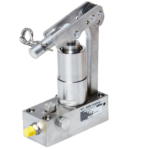
MW-3 or MW-A hand pump mounted on carry around portable or trolley mounted reservoir 5-50 litre capacity; configure to your requirements.
Click here to learn more
Aluminium alloy or 316 stainless, featuring rapid prefill with manual changeover operation up to 1000 bar. Multi-fluid compatibility. Available with fixed and carry around portable or trolley mounted reservoirs, 1-50 litre capacity.
Click here to learn more
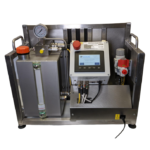
An air operated bench mounting unit for automated cycling of hydraulic pressure between predetermined values to 700 bar. Integrated PLC touchscreen user interface for programming of cycle times, set pressures and number of cycles.
Click here to learn more
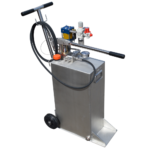
‘DUO’ pneumatic air driven hydraulic pump and single or 2-speed hand pump mounted on 2 wheel trolley reservoir, for rapid fill and operation up to 1000 bar. Configure for requirements with material and sealing options
Click here to learn moreWhat alternatives are there to my PTR-A cycle tester for my composite pressure vessel testing? Do I have to spend a fortune on a composite vessel test rig?
Our hydrostatic pressure cycle tester is used worldwide for testing composite vessels.
The unit is easily programmed using the touchscreen controller with number of cycles, a maximum time for a pressure cycle, a dwell time and a time for a dump cycle. The time allowed by the user for the dump cycle could, for example be 10 seconds but in reality, the venting to zero pressure only takes 0.5 second in the hydraulics. The PTR-A simply dwells for 9.5 seconds. We cannot offer a programmable ramping up and down for pressure as sophisticated valves are required with feedback. The standard PTR-A does include an air flow valve that can be manually adjusted to slow the pump down and users have fitted Swagelok and similar metering valves to the hydraulic section. These are useful, but no substitute for being able to programme in pressure ramping parameters on a mega expensive rig. The PTR-A is a fraction of the cost of a very sophisticated rig.
Even so, customers do use the PTR-A for cycle testing composite pressure vessels. So, how do customers work around any more complicated requirements? If you need something more sophisticated than the PTR-A to test all the parameters that may be required under a standard, you will need to spend considerably more on a test rig. Testing at low and high temperatures is extravagant but achievable on a more expensive rig. We believe that adding the ability to programme in the rate of ramping up or down is very demanding hydraulics. Again, achievable at a price. Finally, the need to work on very high safety factors pushes the maximum working pressure up and up on your rig. Even a 1000 bar rig is only working with 330 bar operating pressure vessels if the safety factor is 3 to 1.
One customer did answer the question on the capabilities of a low cost PTR-A in this application version spending considerably more on a very sophisticated rig. Our customer uses the PTR-A for initial verification work within its capabilities then costs in a Test House to perform testing to a specific standard. Maybe that is a sensible answer.
The future is composite pressure vessel so testing of them is key for safety and cost.
Composite pressure vessels are big. There are just so many applications where they have taken over from metallic pressure vessels. The design then certification of your design is a massive challenge then production pressure testing another key area. Sarum Hydraulics have experience of supplying their programmable pressure cycling tester the PTR-A to composite pressure vessel manufacturers as a low cost catalogue tester rather than an incredibly sophisticated test rig that incorporates temperature control and precise pressure ramping rates. Nevertheless, the PTR-A is still an invaluable piece of equipment to complement of more basic hydrostatic pressure test pumps.
Sarum Hydraulics are the experts on pressure testing for over four decades.
Talk to us about your pressure testing application. We can tell you how our Micropac® Hydraulics can meet your needs. After over four decades, we are the experts.


Leave A Comment