
Why was the Tangye Hydrapak such a great concept hydraulic hand pump and why have today’s Hydrapak, HMP, MHX and PSP hand pumps all evolved that original design so well?
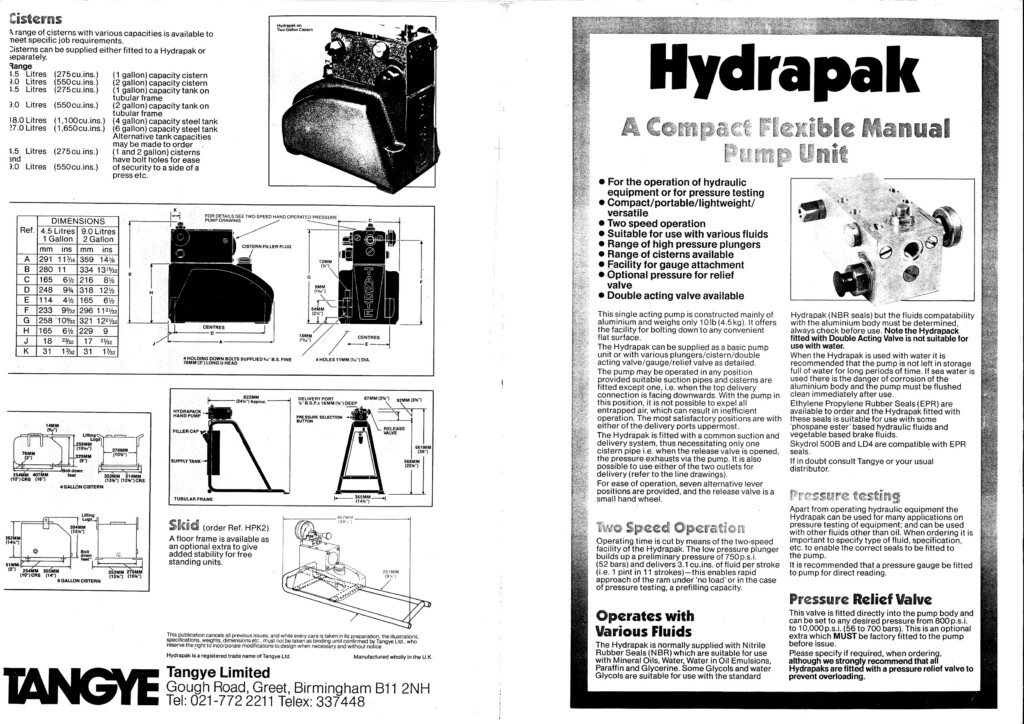
An old Hydrapak product brochure.
The Tangye Hydrapak was the original pump back in the 1960’s. It was a trailblazer. That classic unit is still in production from Allspeeds Ltd. Let’s look at the original and those other pumps that look similar, have the same DNA but have evolved to meet particular needs. These pumps all follow a similar format because the concept was so rugged and effective. We’ll look at how the various histories on different units intersect and what special features there are. The core engineering concept of this format of pump is great.
Tangye were a long-established British hydraulics company going back to 1859. They were very strong on hydraulic jacks sold within a very industrialised Britain and throughout the British Empire. Allspeeds bought them in 1994.
The concept of the Tangye Hydrapak was clever. A two speed hand pump running to 700 bar and beyond with numerous pressure ranges as options. The biggest feature is probably hiding the pump mechanism within the pump body and simply seeing a handle shaft with a square drive. We don’t know what the design process was back in 1960, but the unit was perfect for Tangye’s own biggest high tonnage Hydralite jacks. So, they ended up with a hand pump for their own jacks, a component pump for piping into systems and also a pump and reservoir combination for lots of applications. Tangye offered a cast alloy “cistern” reservoir option. These units were used everywhere. Britain was highly industrialised then with truly massive factories and sites. Think shipbuilding, mining and the car industry just for a start.
What was special about the Tangye Hydrapak?
The 2 speed pump design using six or seven families of low pressure and high pressure pistons in the same body were the basis of the design. You get the same large volume, low pressure output then a smaller high pressure output for your job.
You have hidden the mechanism in the body with just the handle shaft protruding. It is a “bullet proof” concept and keeps dirt out as well.
A rugged manual changeover button is no-nonsense and very reliable. As well as being simple, lots of users genuinely prefer manual changeover especially if you are working at heights or in a confined space. The handle isn’t going to suddenly “give way” unexpectedly as it changes to the high pressure stage.
This basic pump ran for decades with some users on the big Tangye jacks and the rest with a massive range of applications for the pump as its own product. The 700 bar option provided a pump solution to hydraulic power for industry standard 10K hydraulics from the big American players like Enerpac and Power Team. Indeed, Tangye made their own cylinder range to compete with these other firms in that market.
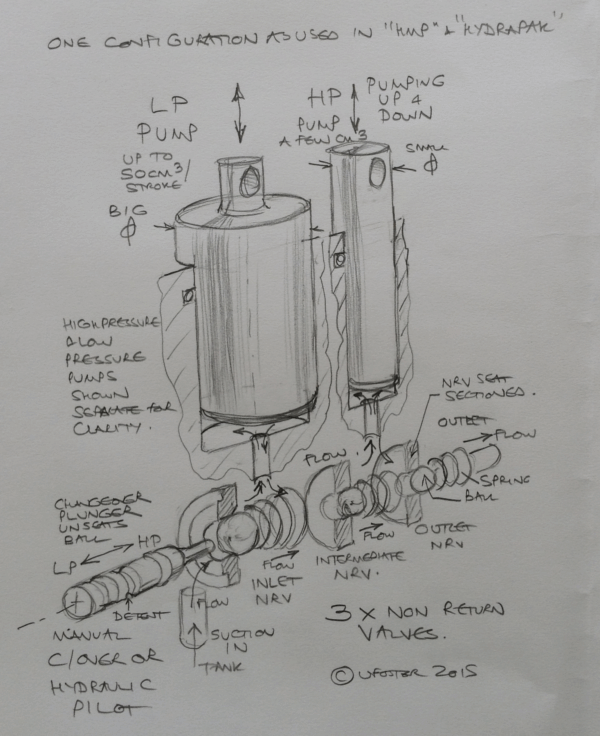
An excerpt from our two speed white paper, explaining how the inlet non return valve design works.
How does the Tangye Hydrapak and similar pumps work?
We like the concept behind the hydraulic design on these two speeders. There are the two pump stages with the inlet check valve, the intermediate check valve and the outlet check valve between them. To run on the high pressure stage, you manually unseat the low pressure inlet check valve. That’s simple. A side benefit is that the high pressure stage always has a modest pressure charge to keep it fed with fluid. That addresses one of the eternal issues with small displacement high pressure pumps.
Read our two speed pump white paper if you are interested in how the various types of two speed pump work. There are different ways of achieving this.
What did we think was so very good on the HMP 2 speed pump?
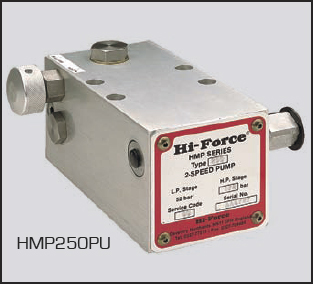
The HMP pump had some great features that broadened the application of the original Hydrapak.
This Hi Force pump was introduced in 1990 and seemed to us to push the format on and improve it. They tweaked the basic concept their own way and there is a lot of original thought there. It used the legacy mounting centres and block size. Those piston rod and pressure options were still there as were the bullet-proof handle mechanism and manual changeover valve concepts. It was just done differently from this second manufacturer. The HMP upgraded to a marine grade anodised 6082T6 body for enhanced corrosion resistance on water and water based test fluids. 100% replaceable seats ensured that a corroded seat in the body didn’t scrap off the pump. Capped pressure seals using an o ring allowed seal kits to be swapped out on very short lead time and at minimal cost. If a user wanted to run the unit on “skydrol” aerospace oil, the pump could be supplied very quickly as there are no special moulded seals. Cartridge release and pressure relief valves allowed users to specify exactly what they needed. Those were all improvements that made a difference. They sold in big numbers for very many years along with the original Hydrapak. Ten or more years ago, Hi-Force moved on with different model numbers and further evolution of the design.
What is the Sarum Hydraulics PSP 2 speed pump and what are the benefits?
Our own two speeder using this format takes the best concepts in the Hydrapak and HMP then adds a little more Sarum expertise in this well proven unit. For over four decades, our own pumps like the Micropac MW have been multi fluid, long life, easy to service with replaceable seals and good value for money. The original Hydrapak was UK made in Birmingham and now Accrington. Our own PSP is made in our Salisbury factory. Both are quality British equipment.
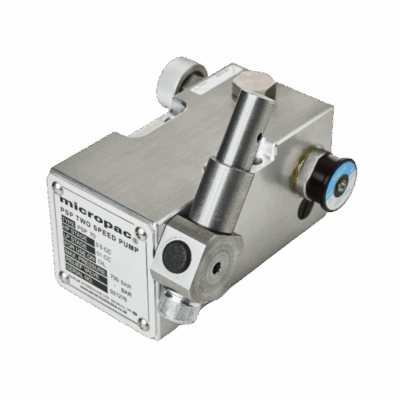
Our own PSP pump is a well-engineered and good value British pump. We are proud of it.
What’s the Enerpac MP?
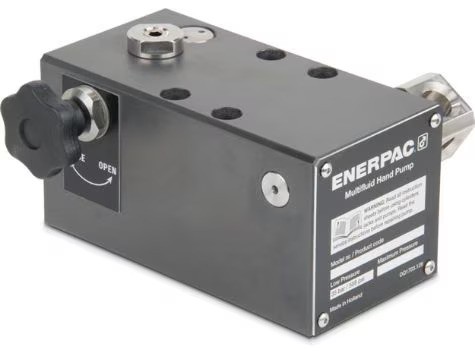
The Enerpac MP pump is a nicely engineered two speeder widely used on systems.
The massive US and International manufacturer Enerpac was always very strong on its own line of two speed 700 bar hand pumps for oil service and working with their jacking and work holding cylinders. The MP was a departure, using the hidden handle mechanism pioneered on the Hydrapak and a square bar stock alloy body. We have no idea how important exact interchange and retrofit are in the marketplace. The Enerpac MP two speeder is still widely used on systems and test rigs. The big difference is the use of an automatic changeover between the low and high pressure stages. That can be a nice touch as the operator does not need to manually press in a changeover knob on the side of the pump. Our take was always that for water and multi fluid use, the manual changeover was very rugged and there was no risk of leaving an auto changeover valve full of fluid for long periods. Corrosion is always a risk on alloy hand pumps. There is also the earlier comment on users liking to be in total control of when a pump changes over. That is just a question of taste. We can only report that the manual changeover seems bulletproof over many years even on water and corrosive fluids. In contrast, an auto changeover is a great choice on oil hydraulics and a slick pump operation. Enerpac must have seen this market and developed their own variant on the format. We have never actually used one but are great fans of Enerpac kit.
Conclusion. A very robust design legacy on this British Product.
The crossover in the histories of the Tangye Hydrapak, Hi-Force HMP, Enerpac MP (in its relevant two-speed manual configurations), and Micropac PSP lies in the widespread adoption and enduring success of a highly effective two-speed hydraulic hand pump design.
Tangye originated and created the market for this particular robust and reliable two-speed manual pump concept with their Hydrapak. Recognizing the appeal of the basic concept of a shaft operated two speed pump with various pressure options, Hi-Force and Micropac developed their HMP and PSP pumps, respectively, explicitly drawing upon and refining the features on the original. Enerpac, as a global leader in 700 bar hydraulics with a broad product range, would also have incorporated these efficient and widely accepted engineering principles into their relevant manual pump offerings.
Essentially, it’s a testament to a “best-in-class” design that proved so effective for general-purpose, high-pressure manual pumping, especially with multi-fluid capabilities, that it became a de facto standard, influencing multiple manufacturers across the hydraulic industry.
We are always pleased to discuss your applications for our PSP two speed hand pump. Contact Sarum Hydraulics or if you know exactly what you need, buy it on-line from PumpShopPro.com, our in-house Micropac distributor.
As always, please correct us if there is something wrong. All Tangye, Allspeeds, Hi-Force and Enerpac trademarks and copyright images are acknowledged.

Leave A Comment