
Why use a pneumatic air driven pump on your hydraulics?
Why do we sell air driven pumps? They are simply a great choice in the right application. We have manufactured our Micropac hand pumps for over 40 years and sell a lot of air driven pumps where they offer features that our manual pumps inherently don’t offer, or adding one enhances our equipment. An air driven pump in a shipping box is just one component. It needs engineering adding to it. We are experts in integrating air driven pumps into Micropac hydrostatic pressure test units, fillers, charge units and programmable pressure test rigs. Look at our PTR-M rugged skid air driven pump, the simple-to-programme PTR-A automated pressure test rig or our innovative DUO combination air and hand pump 2 wheel cart. Talk to us about your application.
What is an air driven pump and how does it work?
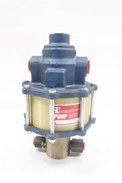
A typical air driven pump. There is a massive range available.
Some people call them air liquid pumps, or air driven hydraulic pumps or even pneumatic driven pumps. We are talking about the same thing. An air driven pump in basic terms uses a compressed air supply to produce hydraulic pressure.
An air pump is non-electric and 100% compressed air. That’s your trusted shop air although odd applications use bottled air or even other gases. If we are talking piston fluid air driven pumps, a larger diameter air cylinder piston is attached to a much smaller hydraulic piston rod. Low pressure air drives the large air piston, exerting a force on the hydraulic piston. The ratios of the areas of large and small piston rods provides intensification and a stepping up in the pressure generated on the fluid side of the pump. Hence a 10 to 1 ratio on piston areas can use 5 bar shop air to generate 50 bar hydraulic pressure. The air piston uses pilot valves and a pneumatic control valve to keep it shuttling backwards and forwards. The hydraulic section of the pump has conventional inlet and outlet check valves to form a fluid pump. In use, you will simply adjust the hydraulic outlet pressure by changing the air inlet pressure on the supply regulator. Air controls including a regulator, filter and a shut off valve will always be connected to the inlet of an air driven pump.
Is a pneumatic air driven pump the same as an air operated double diaphragm pump (an “AODD”?)
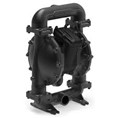
A typical “AODD” double diaphragm air driven pump. They are widely used for low pressures and high flows.
The answer is no. This type of AODD unit is a low pressure large displacement air driven pump which normally uses a pair of elastomeric diaphragms facing each other an air cylinder shuttling backwards and forwards to actuate them. Flow can be large but pressure quite low. They have a big market in the process and food industries where you are shifting larger volumes of fluid. Our customers invariably need higher pressures. They are simply not our thing.
How important is the “stalling” auto pressure top up feature on air driven pumps?
We would say that for a small number of users, it is amazingly useful. It is a massively easier and cheaper way to keep pressure topped up at a particular figure in a system than using an accumulator. An air driven pump can literally keep pressure topped up for months. Apart from keeping a cylinder charged with air, there is no energy used. Some users don’t need this feature at all. If you are pressure testing and seeing whether your gauge reading drops over a few hours, you most definitely don’t want a pump that cycles once and tops the pressure back up. Pressure testers will get to pressure then switch the air supply off, holding the system pressure on the outlet check valves.
Can I automate an air driven pump?
Air driven pumps are very easy to automate by using an air solenoid valve to switch them on and off. That’s a low voltage low power valve. Our PTR-A programmable pressure test rig uses an easily programmed plc to drive an air driven pump. That’s a powerful piece of equipment and illustrates the potential to integrate an air driven pump with a PLC. We have a good White Paper on Pressure test rigs in general, explaining testing parameters. Or learn more about the PTR-A catalogue Programmable Test Rig.
Exactly why do Sarum Hydraulics customers opt for air driven pumps rather than hand pumps?
This is our own experience over many years. Other people may have a different take. The main reason is not having to manually pump a system or chamber full of fluid. Connect shop air and the pump will cycle on and on. Pumping a large number of strokes can be very hard work. Let a compressed air driven unit take the strain.
Which Micropac products use air driven pumps?
We have three families of product that use air driven pumps to achieve valuable features. All offer an innovative solution to real world challenges in the shop or on site.
Micropac PTR-M air driven pump skid.
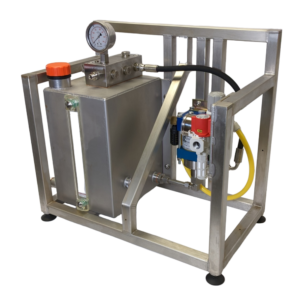
Micropac PTR-M air driven pump skid with 10L reservoir
Customers asked us for a rugged and cost effective skid air driven pump for site and shop. They wanted a stainless steel reservoir and not plastic. They didn’t like odd pipework and discrete valves for the hydraulics which can be vulnerable to damage. The unit is multifluid to 700 bar and can be fitted with a wide range of air driven pumps to suit your application. Learn more.
Micropac PTR-A Programmable Pressure Cycle Test Rig.
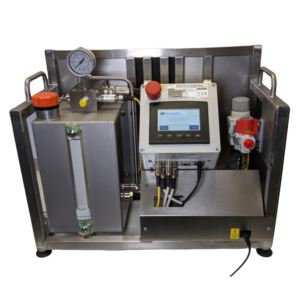
Micropac PTR-A Programmable Pressure Test Rig
This unit was developed for a specific customer request. A simple catalogue programmable pressure test rig available offering excellent value and on reasonable lead time. People wanted an alternative to every rig being a custom unit at high prices and on long lead times. Multi fluid to 700 bar. Test sequences programmable in intuitive touch screen controller. Learn more.
Micropac DUO Combination air and hand pump 2 wheel cart.
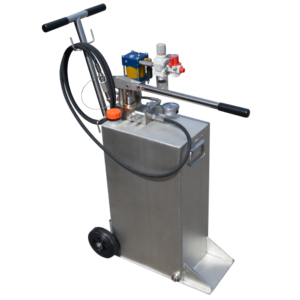
Micropac DUO combined Air and Hand Pump 2 wheel test, charge and fill cart
Whether you are concerned about having no air supply or simply want an automated prefill then precise manual top up, the DUO is an innovative solution based on a neat 2 wheel Micropac Cart. Reservoirs are 10, 20 or 50 litres. Multi fluid up to 700 bar. Learn more.
Is an air driven pump inherently an ATEX unit because it is not electric?
There is quite a lot to unpack in this question so beware. You really need to be very authoritative or at least have a very good supplier if you venture into explosion proof equipment. There is real risk. We have a deep dive into ATEX and IECEx background in our White Paper. Air driven pumps by virtue of not being electrically operated need only satisfy regulatory requirements for non-electrical type of protection against ignition when used in an explosive atmosphere. This would usually be done through constructional safety considerations and the air driven pump will have been certified to an appropriate design standard e.g. ISO 80079-37. You should not therefore use an air driven pump in an explosive environment unless it is certified as suitable for use e.g. ATEX or IEC Ex certified and marked as suitable for the specific explosive environment.
What are the downsides of air driven pumps?
Cost is probably the first issue. The pump in a shipping box may be reasonable in price, but add in air preparation kit, valves, pipework, a reservoir and installation to end up with a far from cheap unit.
We are experts in packaging air driven pumps for sturdy and cost effective solutions. We use our standard Micropac parts to avoid expensive extra valves. For example, on the DUO unit, the air pump module is simply fitted to the catalogue Micropac reservoir lid and the outlet piped into the hand pump module alongside, sharing the release valve and gauge. That is a real cost saving on 316 stainless hydraulics. This approach also makes the hydraulic circuit less vulnerable to damage and leaks as we have less fittings.
The other massive downside of an air driven pump is that if there is no air, the pump does not work. That is stating the obvious but counts for some users. That probably isn’t a big concern for most shops as compressed air is a key resource but our DUO combination 2 wheel cart unit has carved out a strong following for people who need the benefits of an air driven pump but need that hand pump on board for emergencies or even as a fine pressure adjustment tool. Some manufacturers do offer a handle attachment for the air driven pump unit, although the displacement per stroke is invariably small and a lot of strokes are required.
Will a pedal operated workshop air driven pump like the Enerpac PA series provide a good value and easy air driven pump?
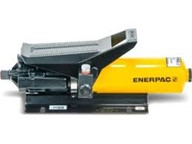
Enerpac PA series 700 bar air driven pump. A handy 700 bar integrated unit for shop and site on mineral oil.
The answer is yes. Very easy to set up and it will work for years. There is a sizeable market segment for a compact 700 bar air driven pump with integral reservoir and pedal operation. Press the pedal down to run the pump and rock it back to release the pressure. Used with cylinders and presses in a production environment they are amazing. Lots of people make them, including Enerpac, SPX Power Team and Hi Force. We use them in our shop. We are fans. They are for mineral oil duty so more restricted to workshop and site cylinders and presses rather than kit running on specialist hydraulic fluids. The pumps are optimised for 700 bar rather than offering a whole range of pressures and flow rates as is available in mainstream air driven pumps like we offer. Although versions of these workshop pumps are available with air operated run and release operation, we would say that they have a relatively narrow application that is very different to our typical customer base. In all these years, we have never been asked about using one for pressure testing or cannibalising a pedal type of unit to change it into something else.
Why aren’t electric pumps in this discussion?
Just to flag this up as it is an obvious question. We rarely supply electric pumps. Down at the volume end of the market, small hydraulic packs for mineral oil are a cheap commodity and even moving to larger electric power packs, they are a catalogue item. Custom power packs and systems area specialist item from people who do this stuff all the time. Lots of people buy our C10-2 cartridge hand pumps and CETOP mount hand pumps to manifold mount or a Micropac MW series unit for tank top or remote mount for a system. After supplying tens of thousands of MT cartridge pumps worldwide for standby use on electric packs, that is where we are on electrics. So, we are assuming you are already looking at an air driven pump, probably for a good reason. Move to electric pumps for water, sea water and specialist fluids and you are into a totally different market and price point. Maybe that is where you open out your search to look at hand pumps and air driven units.
We offer specialist hydraulic hand pumps as standard catalogue parts, not “specials.”
After over 40 years of manufacturing our Micropac hydraulic hand pumps in Salisbury, England, we are the experts. Micropac units with an air driven pump integrated are just one of our products. Contact us to discuss your next requirement.

Leave A Comment