
How do you use a single acting hydraulic cylinder cheaply, effectively and safely?
We are fans of single acting hydraulic cylinders if they work for your application. Read how.
We would always start by asking whether we can use a single acting cylinder. Without a doubt, there are key reasons for using one if you can. Cost and an easy hydraulic circuit. Or there may be important reasons why you can’t. But your system won’t be as simple. At least ask the question. Watch our YouTube video for the difference between single and double acting cylinders. There is some basic stuff there and it is fundamental to your hydraulic design. Cost, effectiveness, complexity and safety all guide your design. We can supply Micropac hydraulics to control either type of cylinder.
Is it a hydraulic cylinder or hydraulic ram?
We would say they are the same component. We are using hydraulic cylinder in this paper.
Why would we try to go down the simple to operate and cheaper single acting cylinder route first?
We would try for the big win if it were possible. The starting point is cost and complexity. The cylinder construction in its most basic form is very simple with a piston rod sliding in a bore with a seal. That is an ultra-easy design. We have used this basic design a lot of times with incredible success. But life gets more complicated. Do you need to limit the piston rod stroke within the cylinder or have you an external stop in the design of the machinery? You must have a stop somewhere to limit the stroke for safety reasons. An integral stop that will limit the amount it can be pumped out makes the single acting cylinder more complicated. You may end up with a piston rod with a piston and seal on it but fitted into a cylinder design that isn’t very far away from a double acting cylinder in complexity.
Hydraulically, the single acting cylinder is so easy. Pressurise a volume of oil, the rod moves and generates load. Lock off the hydraulic pressure with a ball or needle valve. Then release the pressure back to tank. That’s a dependable way to keep your load working for hours, weeks or months assuming there are no leak paths.
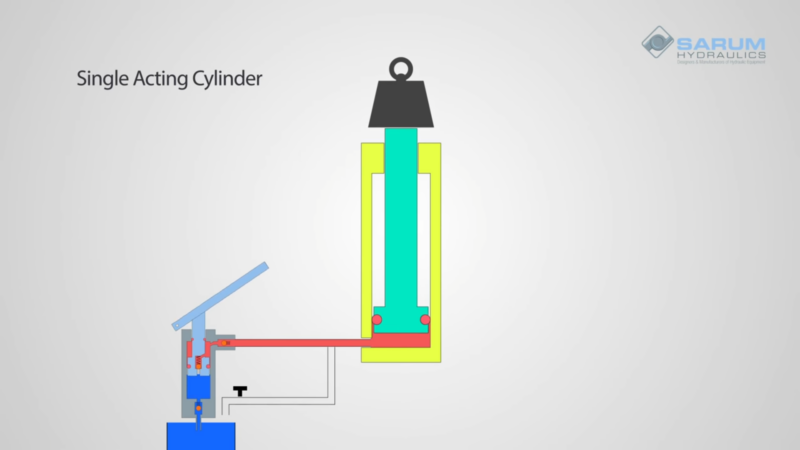
a single acting cylinder set up, with pump
What else is absolutely essential if you use a single acting cylinder?
We have said you need to restrict the stroke so that somebody doesn’t pump it right out with disastrous results. The big additional need is to be able to return the rod using a spring or gravity. A lift truck or scissor lift relies on gravity to allow the load to descend. The operator opens the ball or needle valve and the fluid returns straight to the pump reservoir. If the rod is stuck out and the unit full of oil, your system isn’t working. Watch our video. Do just double check that there is not excessive friction in your design which stops a nice strong gravity or spring return. That can be the fatal flaw in this type of design. Friction can slowly increase with dirt in slides or corrosion. Beware.
Is it just easier to use a double acting cylinder anyway?
We don’t think so as a starting point. We have said that you must have a solid end stop. This might end up being very close to the bearing in a double acting cylinder, with your cylinder being a double acting unit that is just working on the full bore end and the reduced bore side just draws air in and out through a sintered filter. So, you might end up using a double acting cylinder but running it as single acting.
What if we simply decide to run a double acting cylinder and returning the unit under hydraulic power rather than gravity. You are then stuck using a four way directional valve at quite a lot of extra cost. Plus, maybe extra valves to stop the unit descending uncontrolled. If that is where your design goes that is fine. Just try quite hard to use single acting if you can.
If you do have to use a double acting cylinder, read our white paper on double acting cylinders.
How can I be 100% sure of returning the single acting cylinder piston rod into the cylinder bore when I release the pressure?
We have said that you pump up your single acting cylinder to do a job then release the pressure back to tank using a needle or ball valve. You will use a gravity load or external spring to push the rod back and expel the oil. If you don’t do that, the rod will be stuck “out.” Certain types of cylinder are designed to be 100% sure that the rod is returned. Look at 700 bar jacking and load holding cylinders from the likes of Enerpac, Hi-Force and all the other manufactures and they integrate an extension spring inside the piston rod. It is normally an “edge wound” spring wound from flat wire to get the closed length and working range right for the job. Even if the jacking application has a gravity load return, the integral spring return is mighty useful. A decision to use this type of cylinder with the integral return spring inside the rod means you are buying these proprietary units at higher cost. They are more expensive than “industrial” 200 bar cylinders, but some of our customers do go this route. Could you make your own cylinder with a spring inside the rod and make something cheaper or exactly what you want? That’s tricky as the edge wound springs are specialist. Could you fit a spring over the piston rod and acting between the piston and a piston rod bearing? Yes, it works except the cylinder can become over-long to work with the spring parameters. On top of that, you cannot risk a user squashing the spring solid in error.
Just don’t confuse the return spring built into these special jacking cylinders with the gravity or spring return required to return your load on your job. They are two different needs.
What pressure hydraulics should I run my single acting hydraulic cylinder at?
We would say be very careful on diving in too early and opening the wrong catalogue and pressure range. It is a big call.
We have written application notes on the big benefits of 700 bar hydraulics but also another paper on wonderful low pressure hydraulics. There is a place for both points of view depending upon the application. Like every good designer, keep an open mind until you see what particular feature can be leveraged to provide something cheaper, more reliable, lighter or safer. So, we might work out our basic closed lengths, forces, strokes, space envelope and more, then focus on possible solutions. One easy option is mid-pressure industrial hydraulics. The everyday industrial mass market at 200 bar or 250 bar on mineral oil is just massive. A whole range of quality, price and duty cycle equipment. Lots of people would make that their starting point. It is not only the cylinder that available as an enormous range even at low cost, but all the pumps, valves, hoses and ancillaries are also there in the marketplace. If your shop is heavily kitted out with 700 bar Enerpac or Hi-Force, then you may make the decision to opt for 700 bar cylinders from that family. We would spend some time thinking outside the box before diving in, we think. The same is true on low pressure. Assuming pneumatics won’t do the job, people do use single acting cylinders down at 15 bar, similar in concept to pneumatics but on hydraulic fluid. Tonnages will be low unless areas are large, but there may be benefits. Just be careful that your cylinder doesn’t end up rather larger and expensive. “A tie rod cylinder held together with long bolts can offer a cost effective DIY design.” Yes, we think so. Just make sure it isn’t like something from the Stephenson’s Rocket. Do the arithmetic on the cylinder.
The only takeaway from this discussion is that you can get an astoundingly high load from a 200 bar/3000psi single acting cylinder alone. Take that up to 700 bar and loads / space envelope are unbelievable. We have had great results. Of course, this 700 bar high tonnage gear is the whole basis of the 700 bar jacking industry. That was the starting point. Very compact and lightweight kit that produced enormous tonnages.
Conversely, think twice on using 700 bar on your own kit. Yes, the benefits can be amazing but we would say that the physical construction of the cylinder is that much more demanding. For example, long smaller diameter rods are much more demanding on side loading. And the pool of pumps, hoses and ancillaries is much smaller and more expensive.
But we still maintain that using a clever pressure high pressure cylinder may be the thing that really makes the design. We are fans of sub miniature high pressure cylinders, used with great success over many years. For example, we developed a miniature single acting pull cylinder for a military vehicle crew seat scissor lift mechanism used in conjunction with our very small MC series pump.
How do I make my own 700 bar single acting cylinder?
Making your own 200 bar cylinder is pretty easy even if it is picking parts from a catalogue like Steerforth and using a “tie rod” design where the cylinder is held together with four long bolts. That eliminates welding. Or buy a finished cylinder from Steerforth, Wye cylinder or similar suppliers at a range of prices. That’s what we would do. So, is a 700 bar cylinder easy as well? We would say no. We reckon that mass market honed cylinder tube sizes are geared up for 200 bar hydraulics, not 700 bar. Do the calculations. You very quickly have to draw up your own cylinder tube and have it gun drilled/honed. 700 bar cylinders will invariably be high tensile steel. We have already talked about the need to use a mechanical stop of some sort on a single acting cylinder to restrict the stroke for safety reasons. If this is most easily achieved by using a full bore/reduced bore design with a “piston” on your rod and stopping the annulus of this piston on a piston rod bearing, then 700 bar causes some complications. Our experience is that because bores and rod diameters are smaller at 700 bar, an annular stop needs to be carefully designed so there is no permanent deformation at full load. Volume manufacturers commonly use a chamfer on their piston and bearing so that there is no risk of permanent deformation that might clamp the bearing to the rod. Our take is that 200 or 250 bar cylinder design is relatively simple whereas 700 bar brings in an element of development risk unless your buy a proven stock cylinder. That’s just one point. Look at a sectional drawing on proprietary 700 bar cylinders and our point is clear. There are probably a few other observations on 700 bar. There again, in the right application it is a big win because of the high forces and small space envelope.
If my application is a marine single acting hydraulic cylinder, what do I need to know?
The instant you are told that a cylinder is for use in a marine or harsh environment, we would say the alarm bells should ring because expectations may be unrealistic. You can source a suitable cylinder at a price. A common strategy is to use a cheap steel cylinder and swap it out very regularly or alternatively write on the drawing “epoxy coat.” If strategy one of replacing a steel cylinder frequently is the one preferred by your customer, you may be battling. If there is a safety issue and danger to life should a cylinder corrode up, that should seal the argument towards using a proper marine cylinder. The time involved in shut down to replace a cylinder also needs factoring in. Sarum Hydraulics has over four decades experience in supplying Micropac Hydraulics for marine and harsh environments. Talk to us. There are specialist volume cylinder makers for marine applications, like Phoenix or Rotec. Even something like piston rod material is a subject of debate. We have always used hard chrome plated 316 stainless. 431 stainless wouldn’t be our choice.
Hydraulic cylinders can push and pull.
Do keep this in mind. Single acting cylinders can pull and push. Pulling is achieved by pressurising an annular area between the bore and the piston rod. The design just changes. A double acting cylinder can operate in 100% pull mode as a single acting unit.
The end fixings for the rod and the cylinder body are a challenge in themselves.
We have not even mentioned this need. Catalogue cylinders will offer standard options to suit your design. For example, fitting the rod end with a male thread, a cross hole for a clevis pin, a rod end with a spherical bearing in it and of course the option for adjustment on the closed length of the cylinder. There are many options. On the cylinder body, you might go for a cross hole of use a clevis. Look at standard options on web cylinder catalogues.
When should I consider a telescopic cylinder?
Quite simply, when you can’t achieve enough stroke from a short close height. Telescopic cylinders are widely used, ranging from small 10 or 20 hydraulic jacks up to high tonnage plant. Maybe one big application is tipper trucks where you can see them in action. From our perspective, we have never used or made one. There are complexity and cost involved. There are firms who do them very well. Telescopic cylinders are not our thing. “Single acting telescopic cylinders are mainstream products. Double acting telescopic cylinders seem very complicated.” Is that a fair comment?
Can I run my single acting cylinder on eco fluids or even water?
We have an excellent white paper on this very subject.
Sarum Hydraulics are the experts on the optimum hand pump for your single or double acting cylinder.
Talk to us about your hand pump to control your single or double acting cylinder. We can tell you how our Micropac Hydraulics can meet your needs. After over four decades, we are the experts.

Leave A Comment