
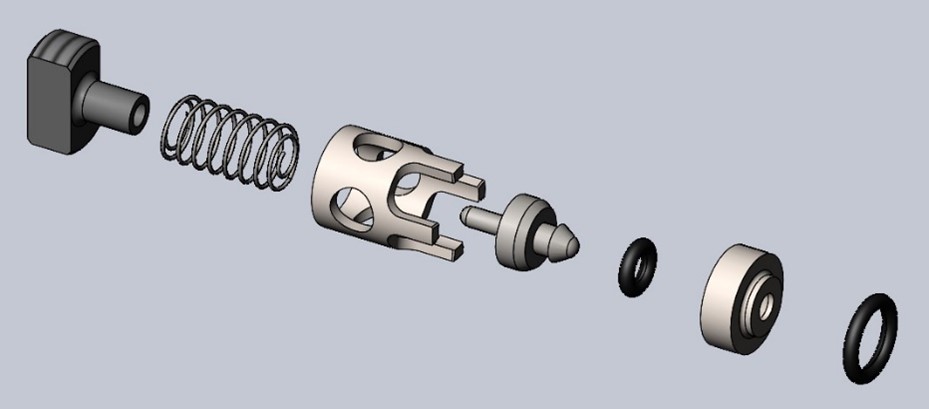
A pump check valve has complexity and needs to be right.
How to design inlet and outlet check valves for your pump.
Are the check valves for a pump the same as catalogue hydraulic check valves?
We would say no. Lots of features are the same but there are some big differences.
Are the inlet and outlet check valves the most difficult thing to design for a pump?
Yes, they probably are. They have to work when you want them to, hold pressure and be long lasting. That can mean millions of cycles.
Is a check valve the same as a non return valve?
Yes. The US call them check valves, which is an easy name for writing. The UK and lots of other languages call them “non return valves.”
Is an air check valve the same as a fluid type?
Yes, up to a point. Air has a very low viscosity so you can get a lot of flow through a small orifice. The downside is that air or other gases are very demanding on sealing and will need an elastomeric seal. A hydraulic fluid check valve may use an elastomeric seal for very good pressure holding but can use a polymer plastic valve seat or even a hard metal seat. It all depends on the fluid and the requirement on pressure holding. Hydraulic check valves are our thing.
Is a pump check valve just a ball on a machined drill point? What is the big deal?
Yes, a check valve can be as simple as a machined seat and a ball “peened” lightly to form a sealing ring. There is detail to design. Spring load? Dimensions? Finishes.? Limitations on ball check valves? A good designer will ensure that when a fitting is removed, the check valve does not fall out. That is very annoying in any product. There is a lot to sort out for a good product.
What are the low pressure and high pressure limits for check valves?
If you are buying them in, the maximum pressure will be stated. The lowest pressure at which they will operate is a different matter and relates to the cracking pressure. You need enough pressure to lift the ball or poppet against a spring load. The check valve is effectively working like a relief valve at low pressures, so do pay attention to cracking pressures if you are working at purely low pressures. High pressure limits are more difficult on valves that you are designing yourself. There are a lot of considerations here. For a ball check valve on a polymer seat, you are limited on load. A ball check valve relies on a narrow sealing area for optimum operation. Excessive load will spread this sealing area out, ultimately over-indenting the seat. That isn’t a good place to be if a valve is going to operate for a large number of cycles. Our experience also tells us that larger contact areas a more susceptible to contamination, although we can’t describe this formally. A poppet with an elastomeric seat has pluses for high pressures. The area is formed by a cone, so the load is spread evenly. If you are using a seal, beware extrusion at very high pressures. Lots of high pressure check valves use a hard ball like tungsten carbide seated on a hard seat. The size of the ball and orifice is trimmed back as small as possible, simply because the loads become enormous as the diameter increases. We think high pressure check valves are specialist. Look what other people do.
What’s the difference between inlet and outlet check valves?
The inlet check valve is on the inlet suction path into a pump and the outlet check valve is on the outlet path of the pump on the delivery side. Both can be similar in design, but each has its own essential features.
So, what is special about an outlet check valve?
There are a few musts. The valve must seal ready for the suction stroke. You cannot have fluid flowing back into the pump from the delivery hose when you stop pumping. If it is an oil pump, a ball on a metal seat may well be perfect. Run on water or low viscosity fluids and you need elastomeric sealing or at least a soft seat.
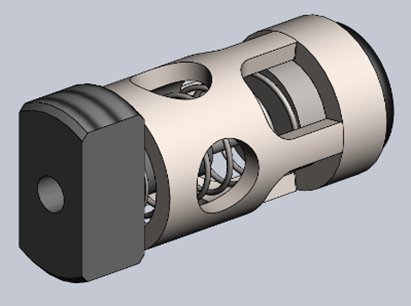
Our Micropac outlet check valve uses a replaceable seat and a guided poppet.
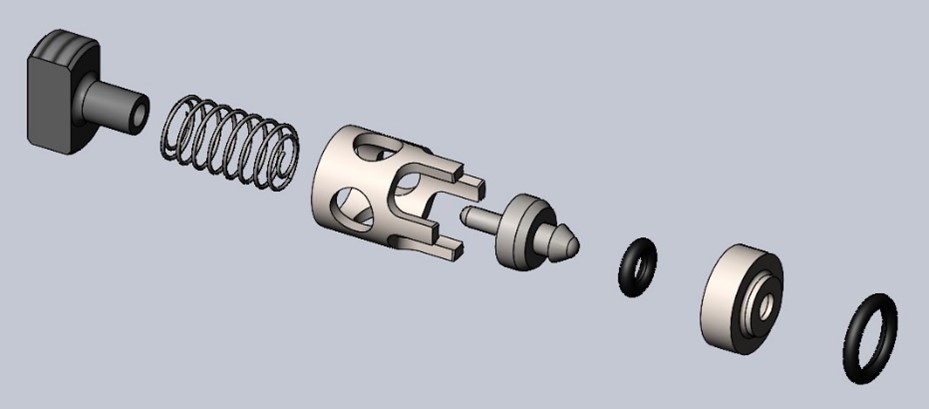
An exploded drawings of our Micropac outlet check valve. They are all our manufactured parts, as this isn’t an off the shelf component for our needs.
Inlet check valves can be very difficult indeed to design.
The same basics apply to the inlet valve in that the valve has to be leakproof or very low leakage. The orifice size on your inlet check valve must be large enough to allow the inlet shot of fluid to be unconstricted even with the most viscous fluid and also at maximum pump speed. Get this wrong and the pump will cavitate, giving a “dead” portion of the stroke.
Where should the check valves be situated relative to the pump barrel?
We would say as close as possible.
Is there an alternative to ball or poppet check valves?
There are alternatives.
Lots of low pressure pumps use simple flap valves. Sometimes these can even be incorporated into a pump gasket for a very simple design. Wire springs are often used on simple flat flaps as trusting a rubber flap to be pushed back onto a seat purely by flow isn’t always robust enough. The rubber can take a permanent set and not be shutting off the seat. A more sophisticated moulding like a “duckbill” valve or the triple Jabsco valve does address this issue. Those are purely low pressure.
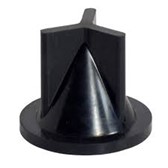
A Jabsco “Joker” moulded check valve Copyright Jabsco
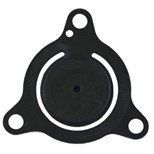
Flap non return valve from a TMC marine toilet.
We would look at how people do it. Look at marine bilge pumps and old automotive fuel pumps. Another option is mechanically opening up or closing an orifice without using balls or poppets that move. Look at a swashplate pump and you will find a valve disc that rotates and opens or closes the correct passages. That is quite exotic engineering unless you are making a lot. Another totally different approach replicates the human digestive system. A pump like a peristaltic pump basically has no check valves. Rollers simply squeeze “charges” of fluid along a flexible hose. That is limited to quite low pressure but is mighty clever. Peristaltic pumps thrive in the right application.
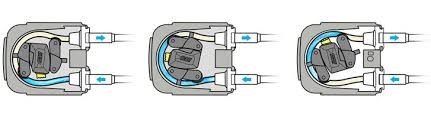
Operation of a peristaltic pump. Image Copyright Watson Marlow
How do check valves fail?
Look at a nicely engineered check valve like the Swagelok products and you will see that the poppet is guided very accurately. If it isn’t, you can find that a poppet or ball can be cycling in an ellipse and start “tracking” which can wear an oval. Ball check valves can do this. Springs can fatigue and break up if they are over-stressed. This is a disastrous failure mode, as fragments of spring can contaminate a system. Contamination is always a risk for check valves. Consider “last chance” strainers for larger and very destructive contamination. That is the extreme but do keep in mind that low leakage does require clean valves.
If Inlet and Outlet check valves for pumps are this awkward, why not just buy them in?
Commercial hydraulic check valves invariably have cracking pressures that are too high. Look to instrumentation valves and you can order Swagelok check valves right down to 1/3psi. BIS is another good UK supplier who we use.
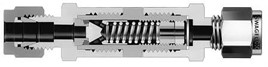
A Swagelok check valve with nicely guided poppet
Image Copyright Swagelok
What check valves do we use in our Micropac pumps?
They are all our own. The medium is largely what drives the valve we use.
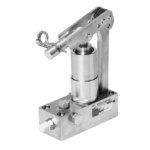
Our Micropac MD series 1000 bar 316 stainless hand pump
After over 40 years, we know a lot about hand pumps and the check valves that go into them. Look at our Micropac range or contact us to discuss your requirement. We are the experts.

This blog provides valuable guidance on designing inlet and outlet check valves for pumps. The detailed steps and considerations ensure efficiency, reliability, and optimal performance in various applications. Great insights!
Thank you, Rohit. We are passionate about hydraulic design, so are very happy to share a few of our secrets after 40 years.