
When do I have to use a double acting hydraulic cylinder and why?
Sometimes, a double acting hydraulic cylinder circuit is the only way to achieve your requirements. What are basic design considerations?
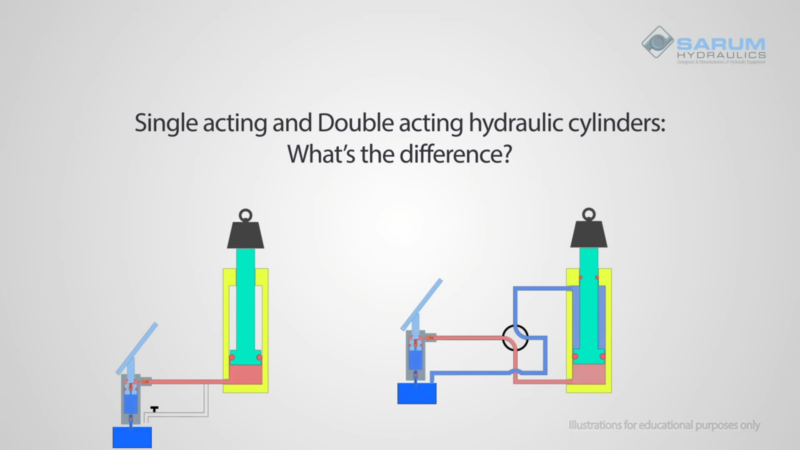
Single versus double acting cylinders. Sometimes your design needs push and pull. The single acting configuration is left and double acting right hand.
We’ve suggested trying hard to use a simple single acting cylinder in our single acting paper. Without a doubt. There are key reasons for using one if you can, coming down to cost and simpler hydraulics. Or there may be important reasons why you can’t. We have now moved on to Double Acting Cylinders. Watch our YouTube video for the difference between single and double acting cylinders. There is some basic stuff there and it is fundamental to your hydraulic design. Cost, effectiveness, complexity and safety all guide your design. We can supply Micropac hydraulics to control either type of cylinder.
Is a hydraulic ram the same as a hydraulic cylinder?
Yes, we would say so.
When do I have to use a double acting cylinder rather than a single acting unit?
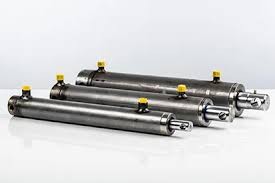
Typical double acting cylinders with full bore and reduced bore connections. Copyright Wye Cylinder
Quite simply, when you don’t have reliable gravity return or can’t use a spring return for the load. You need to retract the ram using hydraulic power. In addition, you might need to go double acting for control reasons. Also keep in mind that on a hydraulic system, you need to be in control and not have anything that could be dangerous. Beware of the nasty design challenge like the load suddenly going negative, for example when a load moves over centre and it moves of its own accord. That is unacceptable. A double acting ram can control this. One example is a crew seat on a military vehicle raised using a single acting cylinder. This design won’t stop the seat carriage from moving towards the roof and hurting the individual if the vehicle overturns. In that case, the seat could crush the driver. The hydraulics won’t know that the vehicle is upside down. Or another example is a heavy engine hatch on a workboat where a single acting cylinder pumps it up to a tipping point then it moves due to its own mass, pulling oil through the pump and running out of control. A double acting cylinder provides a means of locking cylinder motion with extra circuit valves added. That’s a crucial benefit in lots of designs. In summary, you specify a double acting cylinder, a pump with a directional control valve and two hoses or pipes to connect the system up. You might add extra circuit valves for special functionality. Read on for an explanation or watch our explainer video on single and double acting cylinders.
Should I use a double acting cylinder anyway and not consider single acting?
We would say think a design through carefully, including weighing up single and double acting operation. In our single acting white paper, we spend time arguing that single acting provides a simple hydraulic solution because it is very easy to control. Watch our video. You pump up the cylinder, it does its work, the load is held on a needle or ball valve and you release the pressure back to tank when you want it to descend. There is no need for an expensive directional valve with its potential leakage. What you do need is gravity or spring return to make the single acting ram descend. You also need a mechanical stop to prevent somebody pumping the rod out of the ram body. This might move the construction of the ram close to a double acting unit, but we still think not having to use the four way valve is a big plus if it works for you. There is cost and complexity there. So, the answer is that you could potentially use a double acting cylinder on day one. You can use a double acting cylinder in single acting mode with the reduced bore side breathing to atmosphere or you move straight to using a four way directional valve with all that entails. We think you are missing a trick if you don’t at least consider single acting. Read our single acting white paper.
What are the terms for the parts of a double acting ram?
There is a full bore piston diameter and its corresponding area. There is a reduced bore area based on the full bore area LESS the piston rod area. This is often called the annular or reduced bore area. You need these areas to calculate forces. These areas are the first vital piece of information that you need. The rod and piston diameters are the key. Don’t guess them.
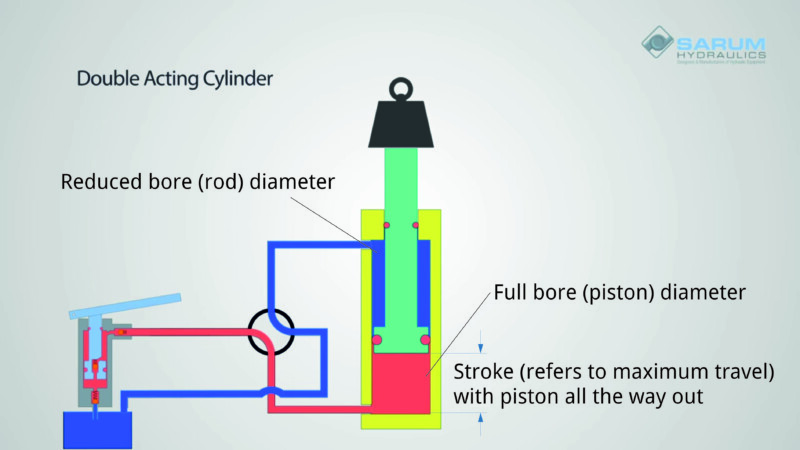
You may already have the actual hydraulic cylinder and be calculating areas around what you already have on your equipment or in your catalogue. The other possibility is that you only know the force you need and you are trying to “size” a cylinder around the available hydraulic pressure. There is a difference there. It is all basic mathematics.
The second key piece of data is the “extension” or “stroke” to do your task. Wise people leave a little stroke in hand at each end in the design process. Having said that, there could be a case where you pump a single acting cylinder out and at the end of the stroke, you use the mechanical stop in the cylinder to limit the movement on your load rather than the slides themselves in the mechanism. Every design is different. If you have the full bore and reduced bores area plus the extension you can work out the amount of fluid required to extend and retract the cylinder. The term “swept volume” is used. This is the second big parameter in a cylinder. This is the information needed to size your hydraulic pump and know how long the work cycle will take.
In summary, the force your cylinder can generate on the extension “push” and retract “pull” is the first big thing. Those are based on the rod and bore diameters. Then make sure you are absolutely clear on the Full Bore Displacement (or “swept volume”) and the Return or Annular displacement. So many times, we have talked to customers who need a pump but don’t actually know these basic parameters. You just need to know them. Remember Force equals Pressure x Area and you will be able to sort your cylinder force. Then area x extension gives the swept volume. Be prepared to be surprised. Hydraulics is so versatile. Displacements can be minute in some designs and you can get away with something like a truly minute cylinder and our sub miniature MC series hand pump. At the other end of the scale, another application might be for a big actuator for a 36 inch pipeline valve and the swept volume is truly enormous. That is two speed pump territory. You can also be shocked by the enormous force that 700 bar hydraulics can generate.
One final thought is to check that you truly know the third parameter, the force. Ensure that the force doesn’t change during the stroke due to geometry. A scissor lift can be a nightmare. Beware. Your system won’t work if you cannot generate enough force at some point.
To help you work out these parameters, we like the Trelleborg cylinder calculator which can be found here:
https://www.trelleborg.com/apps/hydraulic_cylinder/?lang=en
How does a double acting cylinder change the reservoir capacity?
This is very important to designers. A double acting cylinder can be massively useful in a system. As a rule of thumb, cylinder designers often run with the piston area at twice the rod diameter. You could make the rod very spindly, but you are exerting load so you don’t want the rod buckling or bending if there is a side load. Making the rod diameter large and approaching the piston diameter might be a waste of material, although as long as you have enough force generated to retract the rod all is well. Designers commonly like double acting rams because they can reduce the system reservoir volume. As a double acting ram is extended, the fluid from the reduced bore side is connected to tank whilst oil is drawn, pressurised and pumped into the full bore side. The reduced bore side is effectively acting as a reservoir. You can look at almost halving the reservoir volume on double acting cylinders. That might help on the space envelope, but we would suggest that making a larger reservoir is quite cheap whereas the extra hydraulic hassle with the directional valve is significant. Nevertheless, a fair point.
What clever design do actuator manufacturers achieve with a double acting cylinder in a single acting application?
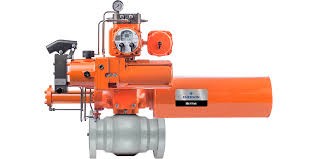
There is clever basic hydraulic design in a valve actuator. Image copyright Emmerson
We have already observed that providing a single acting hydraulic cylinder that has a piston with a seal on it, a bearing for the piston rod that has enough area to support the full load when pumped out plus an annular chamber that is vented to the atmosphere is very close to a full blow double acting cylinder despite not actually needing double acting operation. So, can we leverage these extra features to actually provide a very neat and cost effective hydraulic design? We would say that actuator manufacturers do exactly this.
There are variants on actuator designs where even for a single acting spring return actuator, the designer has used a double acting cylinder. Let us explain this very clever design. If you actuate a spring return single acting hydraulic actuator with just the full bore side of a double acting cylinder, what about putting the spring into the reduced bore side and using this as the reservoir? That’s very neat indeed. You will still have a small additional reservoir to keep the system full of oil and a “make-up” low pressure check valve to allow more fluid into the unit. Add a low pressure relief valve to ensure that the cylinder is always full of fluid when the cylinder is retracted before any excess gets sent back to the top-up reservoir. Then move the design yet further and fit a speed control valve between the two sides of the cylinder. This will control the speed of the spring return. Even on double acting actuators with gas or air powered primary operation, a double acting “slave” hydraulic cylinder fitted with speed control valves can effectively control the speed of opening and closing. Now add in a hand pump with a four way directional control valve and you have a very compact and effective manual override for a double acting actuator.
It is worth looking at actuator designs, as they are well proven and innovative.
How dangerous is intensification on a double acting cylinder?
Intensification isn’t very healthy if you risk doubling up the pressure in part of your circuit. If for any reason, the reduced area leg of your circuit back to tank is shut off, a double acting ram won’t retract. You must let that fluid in the reduced area back to tank. Shut off that leg and you will build pressure. If the areas are around 50% as is common, you can potentially intensify the pressure up to double. That could be enough to deform or damage parts. Dig into the problem rather than risking damage.
We have flagged this up because we have seen it on 700 bar double acting rams with quick-disconnects fitted. A customer had not screwed home the return coupling completely, so it was not forming a return path. That wasn’t very safe.
What’s a regenerative double acting cylinder?
What about a double acting cylinder circuit where in order to extend the ram, you pressurise both sides of the ram? It will extend very fast, as you are only feeding in enough oil to displace the piston rod area. This is an interesting variation on a double acting cylinder circuit. You can use a standard double acting cylinder and a simply changing the four way valve spool configuration. The spool simply connects both sides of the ram to pressure on extension but retains the conventional retract configuration. Pressure will then be connected to the reduced bore and tank to the full bore side.
Who uses this “regen” configuration. We did on one specialist job and fitted a specialist CETOP 2 Bosch Rexroth valve with a “regen” spool. In the wider world, aircraft manufacturers used it to extend the undercarriage on an aircraft for fast action and no real downside. In a commercial hydraulic world, our only caution is that the special spool can make you valve very specialist and on a long lead time.
Sarum Hydraulics are the experts on the optimum hand pump for your single or double acting cylinder.
Talk to us about your hand pump to control your single or double acting cylinder. We can tell you how our Micropac Hydraulics can meet your needs. After over four decades, we are the experts.

Leave A Comment